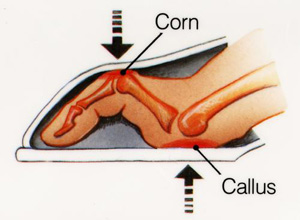
Corns & Calluses

« Previous Entries

Morton’s Neuroma

Thursday, September 24th, 2009

What is Morton’s Neuroma?

Morton’s neuroma is sometimes referred to as Morton’s metatarsalgia, because a true tumor is not believed to be present.  The term neuroma is typically used to refer to a tumor.  But, in this condition, a bundle of tissue fibers presses on nerve tissues.  Basically, it is a pinched nerve. 
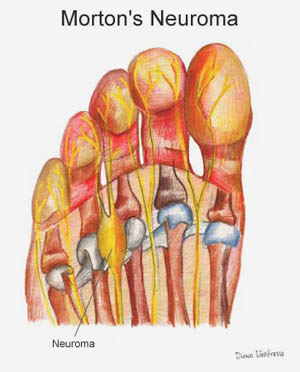
mortons neuroma

What are the symptoms of Morton’s Neuroma?

The usual symptoms are numbness and/or pain in the second, third and/or fourth toes.  A “pins and needles” feeling is sometimes present.  Pain is worsened by wearing shoes, walking or running.  Numbness often occurs after walking for several minutes. 

A shooting pain may be felt between two adjacent toes.  Burning is sometimes used to describe the sensation.  Since nerves are involved, any of these descriptions could be accurate.  The first or big toe is rarely involved.  Neither is the pinky toe. 

The pain can be duplicated by pressing the area of the transverse arch (near the front of the foot) between the thumb and forefinger.  As there are other causes of pain in the toes and front of the foot, evaluation by a podiatrist is recommended.  Other causes can include bursitis or arthritis.   

What Causes Morton’s Neuroma?

Inflammation or enlargement of the ligaments can press on the nerves and cause the pain.  Flat feet, which roll inward, cause excessive “pull” on the nerves. 

Poorly designed shoes that squeeze the front of the feet, which includes a lot of women’s dress shoes, are a common cause of the problem.  As with other foot problems, wearing comfortable, well-designed shoes, such as “Wellness” shoes, can prevent the symptoms and negate the need for further treatment.

How is Morton’s Neuroma treated?

Surgical correction may be necessary, but is usually chosen as a last resort.  Since this is ultimately a pinched nerve, the solution is to stop the “pinching”. 

As mentioned above, the correct shoes can make all of the difference.  For people with flat or flatter than normal arches, a supportive insole can be the solution to the problem.  Other shoe inserts that correct the improper “lean” can help, too.

For people who stand or walk for long periods of time, a forefoot pad with a metatarsal dome will help to distribute pressure more evenly, reducing the shock that can cause irritation and inflammation of the ligaments.  The pads are available from FootSmart.com.

A good massage will relieve the pain and improve circulation.  If you don’t have a masseuse, the VersaPro Thumper is almost as good.

The pain of Morton’s neuroma can be managed and reduced, with the proper treatment.  Start by looking at your shoes and go from there.

  • Share/Bookmark

Overlapping Toes

Monday, September 21st, 2009

All about Overlapping Toes

Unless you were born with overlapping toes, the most likely cause of the problem is continuously wearing shoes of a poor design or those that fit poorly.  There are, however, other causes that bear mentioning. 

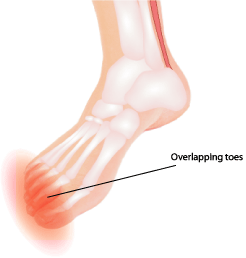
overlapping toes

The Causes of Overlapping Toes Include

Rheumatoid and psoriatic arthritis can cause deformities in the joints, which can cause the toes to overlap or press on each other.  Any of the joints of the toes and feet can be affected. 


Hammertoes are sometimes seen as overlapping.  The hammer toe deformity usually occurs in the joint closest to the back of the toe, opposite the toenail.  The ends of the toes point downward like a hammer or mallet. 

Mallet toe is similar to hammertoe, but the deformity occurs in the joint closest to the end of the toe or toenail.  In the second, third and fourth toe there are two joints.  Either one can become deformed.

In Charcot foot, the big toe leans against the second.  The most common cause of Charcot foot is diabetes, particularly when it is poorly controlled.

A bunion on the big toe or a tailor’s bunion on the small toe can cause the toe to bend in towards the other toes.  This misalignment can cause any of the toes to overlap and should be addressed as soon as possible.

Congenital abnormalities or birth defects may be the cause.  If that is the case, other symptoms may or may not be present.  The condition is usually diagnosed at birth and other symptoms are evaluated to see if the problem is more serious.

Problems Caused by Overlapping Toes

Overlapping toes can cause the formation of calluses and corns.  Blisters may form when walking or running.  The rubbing can lead to infection or ulceration.

As the pain and irritation becomes worse, the rest of the joints of the feet may be affected.  Pain in the heels, ball of the foot, knees and lower back may occur, as posture is negatively affected.  Unconsciously, people change the way that they walk, in order to reduce the pressure on the bent toe.

Treating Overlapping Toes

Stretching and retraining the toes to straighten them is possible, without surgery, if you begin soon enough.  Corn pads and cushions can and should be used to provide temporary relief and to prevent additional deformities to the other toes.

A variety of spacers, trainers and cushions are available from FootSmart.com.  Start taking better care of your feet, today.

  • Share/Bookmark

Hammertoes

Sunday, September 13th, 2009

What are Hammertoes?

A hammertoe is a deformity that can occur from a number of causes.  It is so called, because the toe(s) resemble a hammer.  They are permanently bent at the joints, rather than lying normally.

While this deformity can occur on any toe, it is most common on the second, third or fourth toe and affects the joint closest to the end of the toe.

hammertoes

A similar condition is mallet toe, which affects the upper joint, closest to the foot.  If the joints of the pinky or big toe are affected, it is a different condition.

What are the Symptoms of Hammertoes?

Other than the deformity, there may be pain, chafing, blistering, corns, calluses or other forms of irritation caused by one toe leaning against the other or by the way the joints press against footwear. If the condition is allowed to worsen, walking can become painful and difficult.

What are the Causes of Hammertoes?

A muscle imbalance from an unnatural walk, painful conditions affecting the bottom of the foot, such as corns, plantar warts or calluses, poorly fitting shoes, flat feet and high arches are among the most common causes.  In addition, the deformities may accompany arthritis, stroke, Charcot-Marie-Tooth disease and diabetes.

How Can Hammertoes Be Treated?

There are many suggestions for successfully treating hammertoes.  Buying new shoes with soft, spacious toe boxes is the first order of business.  Avoid high heels and other styles with unnatural narrow, pointed toes.

It is possible to be stylish without cramping your feet.  Shoes by Aetrex, Beacon and Arcopedico are stylish and dressy, yet comfortable and foot-friendly.

Treating problems, such as corns and calluses, is the next order of business.  If the toes are curling in order to take pressure off of a painful area on the bottom of the foot, addressing that issue will allow the toes to gradually straighten.  Gel comfort insoles, corn pads, callus removers or a trip to the podiatrist to treat a wart could be beneficial.

If the problem is caused by a problem with the arch that puts too much pressure on the joints of the toes, arch supports may be beneficial.  Shoe inserts, as well as custom orthotics are available from Foot Smart.

Once the cause of the issue is addressed, toe trainers and straighteners can be used at home to realign the joint, before the deformity becomes severe.  Hammertoe straighteners from Foot smart are affordable, help to correct the problem and provide pain relief, in the meantime.

Toe exercises can be done at home, too, to stretch and strengthen the muscles.  One simple exercise is to use the toes to pick up small objects off of the floor.  If the muscles are not quite that strong, lay a towel flat on the floor and use your toes to crumple it.  The muscles will get stronger as time goes by and that will help to straighten out the joint.

If physical therapy or at-home straighteners are ineffective, orthopedic surgery may be necessary to correct hammertoes.  But, that’s a last resort.

  • Share/Bookmark
« Previous Entries