Ball-of-Foot Pain
Plantar Fasciitis
Saturday, September 26th, 2009What is Plantar Fasciitis?
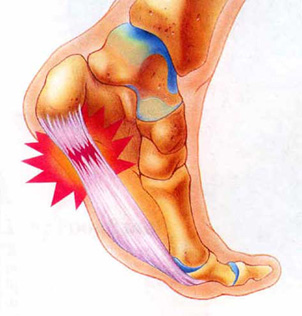
Plantar fasciitis is inflammation of the ligament that stretches from the back of the heel to the ball of the foot. Known as the plantar fascia ligament, it is responsible for supporting the arch of the foot. It is one of the most common conditions that affect the feet, occurring in about 10% of all Americans at some point in their lifetime. Reportedly, some two million Americans seek treatment each year.
What are the symptoms of Plantar Fasciitis?
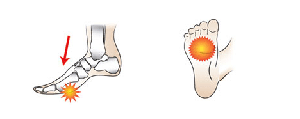
Pain, located at the bottom of the heel, is the most common symptom. The pain is often most intense during the early morning, accompanying the first few steps of the day. Difficulty flexing the foot so that the toes point upwards in the direction of the shin is another symptom, although many people do not notice the stiffness, as it occurs gradually over time.
What Causes Plantar Fasciitis?
In athletes and runners, the cause is often inadequate stretching. In non-athletes, the condition is more common in people that are overweight.
Standing or walking for many hours during the day is a common cause. It is sometimes a work-related injury. Running, especially in shoes with little or no arch support, can eventually cause the ligament to become overstretched. The arches can fall and pain is the result.
Flat feet and fallen arches can cause plantar fasciitis, although the pain from fallen arches may affect the entire foot. In plantar fasciitis, the pain is focused primarily on the bottom of the heel. High arches can cause the problem, too.
Although they are not believed to be a cause, heel spurs are often found to accompany plantar fasciitis. Spurs are bone deposits that form on the heel bone. They can form on the back or bottom of the heel bone. When they accompany plantar fasciitis, they are usually found on the bottom of the heel bone.
How is Plantar Fasciitis Treated?
Surgical procedures can release the tension, but they are accompanied by numerous risks, which include injury to the nerves, infection and rupture of the ligament. In addition, surgery does not always reduce or relieve the pain. So, it is typically chosen as a last resort.
Injection of corticosteroids or the use of non-steroidal anti-inflammatory drugs (NSAIDs) is sometimes chosen to relieve pain, but those treatments are of limited benefit. Side effects are a problem, as is damage that can be done to the liver, with continued use of NSAIDs.
The best choices for treatment are those that do not involve drugs or surgery. If you suffer from the condition, here’s what you should do.
- Choose comfortable supportive shoes, designed specifically for your activities—orthopedic shoes are a good choice
- Use a brace that can be worn underneath the shoe to provide additional support for the plantar fascia tendon—Foot Smart is a good brand
- Use a special brace at night, when the muscles tend to tighten up, causing pain in the morning—the Passive Night Splint provides relief for many people
- Arch cushions and insoles to be used in your own shoes are another option
If you follow these steps, you should notice an improvement in your plantar fasciitis in a very short time.
Custom Orthotics
Sunday, September 6th, 2009What Are Custom Orthotics?
Orthotics is actually the medical field relating to the design, development, manufacturer or fitting of devices designed to provide additional support or correct imbalances in the muscles or bones of the body. But, the term “orthotics” is also used to refer to the devices created by those professionals.
Custom orthotics are devices that are sized to fit a specific person. When it comes to the feet and lower body, appliances that fall under the heading of custom orthotics include shoes, braces and insoles of various types.

What Are Custom Orthotics Used For?
Insoles may be used to:
- Provide additional support to the arches of the feet
- Act as shock absorbers during sports or other activities
- Reduce friction and improve the comfort of hiking boots
- Provide additional warmth in cold weather
- Help prevent or control pronation
- Provide additional support for the heels
- Correct leg-length discrepancies
- Relieve pain in specific areas of the foot
Braces may be used to provide additional support for the knee or ankle. In some cases, the braces are therapeutic; used to provide compression or cold therapy. Special braces for the toes are used to separate and straighten.
Therapeutic or orthopedic shoes may be used as an alternative to insoles. They can provide many of the same benefits.
Who Could Benefit from Custom Orthotics?
Many people can and do benefit from custom orthotics. Practically anyone could benefit from an insole, but there are specific conditions that can be relieved with an orthotic device.
- Flat feet or fallen arches—use insoles with additional arch support or an arch brace. Pro Arch orthotics, for example, are shoe inserts made from polypropylene, which flexes and springs with every step.
- Knock kneed, bow-legged, pronation, suppination—in these conditions the heels angle inward or outward, causing pain in the feet, knees and hips. Foot Smart Corrective Heel Cups provide relief by correcting the misalignment. Anti-pronation insoles are another option.
- Hammertoes, overlapping, crooked or misshapen toes—toe trainers, straighteners or separators can be used to correct the problem and relieve the pain.
- Diabetics and others with sensitive feet—Arch Crafters custom-fit insoles relieve pain in the heels, knees and back by eliminating pressure points on the bottom of the feet. A foam box is used to create a cast of your feet at home, so there is no need to see a podiatrist.
- Runner’s knee—knee braces can be used to provide added support during sports and other activities, in order to prevent and relieve knee pain.
Custom orthotics may also be beneficial for arch, ball of foot, heel, ankle, knee, hip or back pain. Healthy pain-free feet provide the right foundation for a healthy pain-free lower body.
Ball-of-Foot Pain
Tuesday, September 1st, 2009What is Metatarsalgia?
Metatarsalgia or ball-of-foot pain is something that many people experience from time to time. It is more common in some people than others. Here you can learn how to identify the area, find the causes, treat them and avoid the pain in the future.

What is the Ball of the Foot?
If you look at the bottom of your foot, you will see the area where the bases of the toes meet the rest of the foot. The area is muscular and easily blistered. Runners and ballerinas try to keep most of their weight on this area to achieve better balance.
Metatarsalgia is the diagnosis given, especially when the pain is concentrated in the area beneath the largest and second largest toes. It is commonly referred to as a stone bruise.
What Causes Ball-of-foot Pain?
There are many things that can cause it. It is a relatively common problem, occurring in athletes and non-athletic types alike. The area takes a beating.
Wearing high heeled shoes can cause the problem, because of the increased and unnatural pressure put on the area. Dancing on the toes, as a ballerina would can cause the problem, but dancers typically become somewhat toughened and toe shoes help.
A minor injury, like stepping on a stone, is a common cause. Simply, coming down on the ball of the foot too hard can cause it, too. Hard soled shoes with little support increase the risk of injury. Corns or calluses in the area are common and very painful, as well.
How to Treat Ball-of-foot Pain
There are a number of different insoles and cushions specifically designed to relieve the painful condition. Many of them will also help take pressure off of corns and calluses. Here’s a look at a few products.
Silipos Ball of Foot Cushions
This thin gelatin-cushion acts like a shock absorber. It is designed to fit comfortably under socks and shoes, which should always be worn until the area heals. In other words, avoid going barefoot and risking additional injury. Click Here for Silipos Ball-of-Foot Cushions
Foot-Smart Metatarsal Sleeves
A large circle of soft gelatin sits directly under the ball of the foot to protect it from pressure. The elastic band keeps the gelatin-circle in the right spot as you walk. Click Here for Metatarsal Sleeves
Metatarsal Insoles
Metatarsal insoles are designed to provide extra support to the ball of the foot. Unlike the cushions and sleeves, they fit into the shoe, instead of around your foot. Some people feel that the design is cooler and more comfortable than other options.
How To Prevent Ball-of-foot Pain in the Future
Always choose shoes with a low heel that fit well. Gelatin insoles are a good option.
Unless you are walking on a clean beach, avoid going barefoot. Remember that our shoes protect us from injury.
While occasional pain is common, chronic pain in the area can be due to wearing a shoe that is too tight, which can cause the formation of a bunion. Choosing a wider size can help prevent ball-of-foot pain, bunions and similar problems.

