Corns & Calluses

Next Entries »

Foot Corns & Calluses

Tuesday, September 8th, 2009

What Are Foot Corns & Calluses?

Foot corns & calluses are among the most common problems that people have with their feet.  A callus is a toughened area composed of dead skin, making it thicker than the surrounding tissue.  A corn is a callus that has a specific shape, which is something like an ellipse.
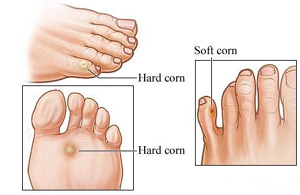
foot corns

A callus is usually white in color and resembles a hardened blister.  A corn is usually yellow in color and may be either soft or hard.  Hard corns are typically found on the outside of the largest or smallest toes.  Soft corns typically form between the fourth and fifth toes, but may be found between the other toes, as well.

What Are the Symptoms of Foot Corns & Calluses?

Other than the hard, rough skin, there may be no symptoms, at all.  People often say that foot corns & calluses are painful, but they are composed of dead skin.  So, there are no nerve endings.  What is actually painful is the additional pressure placed on the joint or other part of the foot when shoes are worn.

What are the Causes of Foot Corns & Calluses?

The initial cause of a corn or callus is pressure.  It may be easier to understand if you think about the calluses that form on a guitarists fingers or a bowler’s thumb.  Calluses form on the hands in response to repeated friction.  They actually help to protect the fingers from damage.

When a corn or callus forms on the feet, the probable cause is poorly fitting or poorly designed shoes.  For example, shoes with narrow pointed toes are the most common cause.

Moisture between the toes can lead to the formation of soft corns, because of increased friction.  High heeled shoes can cause the formation of corns or calluses on the balls of the feet, because of increased pressure in that area.

The shape of the corn is related to the circular rubbing pressure that is continuously placed on the foot or toe.  By looking at the shape or location, you may be able to identify which shoes are doing the rubbing.

What are the Treatments for Foot Corns & Calluses?

The first step is to stop wearing shoes that place pressure on the sides of the feet or toes.  Choose a suitable width, made of a softer material that applies little or no pressure. 

If you must wear dress shoes made of hard leather, invest in a shoe stretcher with attachments to create a little extra space in the location of the corn or callus.  The Foot Smart Fit Right two-way shoe stretcher comes highly recommended. 

Insoles can be used to reduce pressure points and rubbing.  Padding of various materials can be used to further reduce pressure or to cushion a blister and prevent a callus from forming.

Pumice stones can be used to smooth down calluses and a callus treatment cream can help, too.  With the right shoes and a few accessories, you can say goodbye to foot corns & calluses for good.

  • Share/Bookmark

Diabetic Foot Care & Diabetic Neuropathy

Monday, September 7th, 2009

Diabetic foot care encompasses steps that are aimed at preventing infection and relieving the pain associated with diabetic neuropathy. 

What is Diabetic Neuropathy?

A neuropathy is a disorder that affects the nervous system.  A diabetic neuropathy can affect nearly any part of the body, but the feet are typically affected first. 

Neuropathies do not affect the central nervous system, which includes the brain and spinal column, but the peripheral nerves which transmit signals to the brain, via the spinal column.  In diabetic neuropathy, the nerves are not functioning properly.  So, the signals that are transmitted to the brain are abnormal.
diabetic foot care

What are the Symptoms of Diabetic Neuropathy?

The symptoms of diabetic neuropathy vary, depending on which nerves or which area of the body are affected.  Since we are focusing here on diabetic foot care, the symptoms may include:

It is important to recognize the symptoms and spend extra time inspecting the feet, checking for injury or infection on a daily basis.  Infections can go unnoticed leading to ulceration and gangrene.  In some cases, partial or total amputation is required to prevent blood poisoning. 

What Causes Diabetic Neuropathy?

High glucose or blood sugar levels over a long period of time cause damage to the blood vessels that supply the nerve endings, throughout the body.  Since, the blood vessels and the nerves in the hands and feet are some of the smallest; those are the areas of the body that are affected first. 

The nerves and the blood vessels depend on each other.  The nerves control dilation and constriction of the blood vessels.  In order to function properly, the nerves need adequate blood flow.  If blood flow is reduced, the nerves may cause constriction of the blood vessels, which further reduces the blood flow.  Eventually, the nerves can simply die, due to lack of oxygen and nourishment from the blood.  When the nerves die, the blood supply to the toes and other extremities is reduced even further.

diabetic foot nerves
So, the condition may become progressively worse, even when blood sugar levels are kept under control with medication and proper diet.  Doctors theorize that in type II or adult-onset diabetes, the earliest damage may occur before a person even realizes that they have diabetes. 

How Is Diabetic Neuropathy Treated?

Prescription drugs, such as anti-depressants or anticonvulsants may be prescribed, but there are no treatments, currently, that will reverse neuropathies.  Tight blood glucose control is essential to help prevent the conditioning from progressing rapidly.  Effective diabetic foot care helps to relieve the pain and prevent the most serious complications.

What Are the Essential Steps for Diabetic Foot Care?

1.  Inspect your feet daily.  Use a mirror if necessary to see the bottoms of your feet or the area between your toes. 

2.  Any sores or blisters should be treated with an antibacterial ointment and covered with a bandage or treated by a physician.  Do not attempt to remove corns, calluses or ingrown toenails at home.  See a podiatrist in the case of swelling, increased redness, pain or signs of infection.

3.  Use a good moisturizer or lotion on heels and feet, but not between the toes.  The area between the toes is prone to dampness, which creates an environment for fungal infections.  There are a number of different moisturizers to choose from.  Each has different benefits, depending on the ingredients.  Lotions recommended by podiatrists include:

4.  Never go barefoot.  A splinter or tiny scrape can lead to a serious infection, because of reduced sensation and because of reduced blood flow. 

5.  Wash your feet daily with warm (not hot) soapy water.  Do not use a heating pad or hot water bottle to warm cold feet, a burn could occur.

6.  Trim your toenails carefully and cut them straight across the top, to avoid an ingrown nail.

5.  Wear seamless socks that do not restrict circulation.  Choose orthopedic or therapeutic footwear designed specifically for diabetic foot care. 

There are a number of different orthopedic shoe styles to choose from, as well as seamless socks designed specifically for diabetic feet.  They will not restrict circulation, but resist sagging and bunching.

Another good alternative for diabetic neuropathy and diabetic foot care, in general, is the Arch Craft customized insole, which can be worn with your own shoes.  They cradle your feet in comfort, eliminating pressure points and pain, without restricting circulation.

  • Share/Bookmark
Next Entries »